How To Size Golf Clubs For Kids
Buying junior golf clubs for your child is much easier when you know how to measure them properly.
Many kids’ golf clubs are sold by age, but age is only a rough guide. Height, strength and how comfortably your child can swing are much more useful when choosing the right size. A tall seven-year-old and a smaller seven-year-old need very different clubs.
This guide explains how to measure kids for golf clubs, how to use your child’s height as a starting point, and what to check before you buy.
Why measuring your kids’ golf clubs matters
Golf gear can get expensive quickly, especially when your child is growing fast. Measuring helps you avoid buying clubs that are too long, too heavy or too difficult to control.
The right size should help your child stand naturally and swing without forcing the movement. If the clubs are too long, your child may bend awkwardly, lose balance or work too hard just to move the club.
That is why it is better to start with your child’s height instead of relying on age alone.
What size golf clubs for kids?
There is no single answer to what size golf clubs for kids, because children grow at different speeds.
As a simple rule, start with your child’s height. Age labels can help you browse, but they should not be the final decision. A junior golf set marked for ages 9–12 may fit one child well and be completely wrong for another.
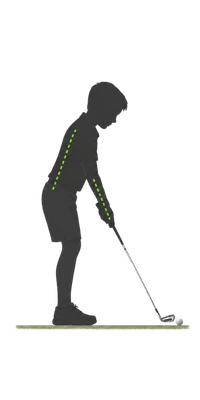
The right size is the one that lets your child stand comfortably, swing freely and control the club without fighting it. If they have to stretch, stand too upright or hunch over too much, the clubs are probably not the right fit.
If you are unsure, ask for help before buying. Most pro shops can measure your child and give basic size guidance, often for free. Coaches and academies can also help, especially if your child is already having lessons.
How to measure kids for golf clubs
The simplest way to measure your child for golf clubs is to start with their height.
Ask your child to stand upright against a wall, wearing the shoes they would normally wear for golf. Their feet should be flat, shoulders relaxed and head straight. You can lightly mark the top of their head on the wall or place a book flat on their head, then measure from the floor to the mark.
Write the measurement down in centimetres and inches if you can. Some brands use centimetres, while others use inches.
Use the brand’s own kids golf club size guide
Many brands have their own size guides for kids’ golf clubs, so it is worth checking the guide for the specific clubs you are considering. PING, for example, has a WebFit Junior tool for its Prodi G range, while U.S. Kids Golf uses a detailed height-based fitting system. Other brands, such as Callaway, TaylorMade, Wilson and Cleveland, usually offer simpler height charts for their kids’ clubs.
These tools are helpful because kids golf clubs are not all built the same. One brand’s “age 7–9” may not match another brand’s medium exactly. Your child’s height is still the best starting point, but the brand’s own chart can help you narrow down the right size before you buy.
It is also worth asking a local pro shop to measure your child in person, especially if you are buying second-hand or comparing different brands.
| Brand | What they offer | Useful? |
|---|---|---|
| PING | WebFit Junior – An online fitting tool for PING Prodi G kids golf clubs. | Very useful if you are considering PING clubs or want to see how a more detailed fitting works. |
| U.S. Kids Golf | Fitting Center – A detailed height-based fitting system with different kids ranges. | Very useful because U.S. Kids Golf has one of the most detailed kids’ sizing systems. |
| Callaway Junior | XJ Sets – kids golf clubs grouped by size and age range. | Helpful if you are comparing ready-made Callaway sets. |
| TaylorMade Junior | Set Sizing – A simple kids sizing guide based on age and height. | Helpful as a quick check before buying a TaylorMade junior set. |
| Wilson Profile | Set Guide – A guide to choosing the right Profile clubs, including kids sizes. | Useful if you are looking at Wilson beginner clubs. |
| Cleveland Junior | Kids golf clubs available in small, medium and large size options. | Helpful for a basic height-based comparison. |
| The Pro Shop Junior | Equipment Guide– A South African guide to choosing golf equipment for children. | Useful locally, especially if you want South African sizing and buying context. |
Measuring golf club length for kids
Golf club length is measured from the end of the grip to the bottom of the clubhead, with the club resting in its normal playing position. A driver, iron, wedge and putter will all have different lengths, so there is no single club length that applies to every club in their junior golf bag.
You usually do not need to measure every club when first buying. It is more useful to know your child’s height and then compare the clubs with the brand’s size guide.
Club length becomes especially useful when you are buying second hand junior golf clubs online. Ask the seller for the actual club measurements, clear photos and, if possible, the height or age of the child who used the clubs before.
After that, let your child hold the clubs if you can. If they can stand naturally, lift the club comfortably and make a gentle swing without losing balance, you are much closer to the right fit.
Measuring kids’ golf clubs in a golf shop
One of the easiest ways to size kids’ golf clubs is to have your child measured in a golf shop or pro shop. Some shops use a simple fitting stick, like the one used in the video below, to check which club length suits your child’s height.
This is usually a quick process. Your child stands next to the measuring guide, and the fitter checks which size range they fall into. From there, they may also let your child hold a club and take a few practice swings to see whether the club looks comfortable.
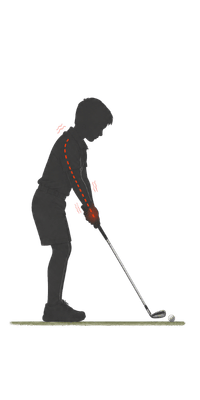
The important thing is not just height, but how your child stands with the club. If the club is too long, they may stand too upright or struggle to control the swing. If it is too short, they may hunch over too much. A good fit should allow them to stand naturally, with relaxed arms and enough control to swing without fighting the club.
This kind of basic fitting is especially helpful before buying first golf clubs or shopping second-hand online. Even if you do not buy from the shop on the day, you will have a much clearer idea of what size kids’ golf clubs to look for.
Measure your child in the shoes they would normally wear for golf. That could be golf shoes or comfortable trainers, depending on where they are playing.
Measuring with shoes on gives you a more realistic playing height than measuring barefoot. You are simply trying to match the club size to how your child will actually stand when they play.
How to tell if kids’ golf clubs are the wrong size
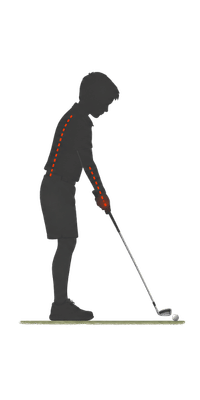
Clubs may be too long if your child has to stand awkwardly or reach too far from the ball.
You may also notice that the club feels difficult to control, especially at the top of the swing or through impact. If the clubhead seems to pull your child off balance, or your child cannot swing without adjusting their posture too much, the clubs may be too long or too heavy.
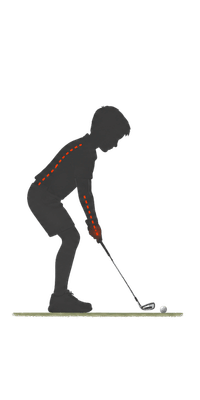
Clubs may be too short if your child is bending over too much or looks cramped at address.
This can happen quickly during growth spurts. One month the clubs look fine, and the next your child suddenly looks hunched over the ball.
Weight is just as important as length.
Clubs may be too heavy if your child struggles to lift them, loses balance during the swing or gets tired quickly. You may also notice that they cannot finish the swing properly, or that they are using too much effort just to move the club.
Should your child grow into their golf clubs?
It is tempting to buy clubs slightly too big because kids’ golf gear is not cheap.
A little bit of growing room can be fine, especially if your child is close to the next size. But clubs that are much too big can make the game harder. Your child may start changing their posture or swing just to manage the club.
For younger beginners, it is usually better to choose clubs that fit properly now. Good second-hand clubs that fit are often a better choice than brand new cubs that are too big.
Measuring before buying kids golf clubs online
When buying online, check the size guide before you look at colour, brand or price.
Have your child’s height ready, then compare it with the height range for that specific clubs. Also check whether the clubs are right- or left-handed, what clubs are included, and whether the bag is part of the package.
It is also worth checking the return or exchange policy. Sizing can be tricky, and it helps to know what your options are if the clubs arrive and do not feel right.
Measuring before buying second-hand
Second-hand kids clubs can be a great option, but measuring becomes even more important because you may not have the original size chart.
Start by measuring your child’s height. Then ask the seller whether they know the age range, height range or size label of the kids clubs. Some brands use colour codes, height bands or age guides.
When you view the clubs, let your child hold them if possible. Check whether they look too long or too short, and whether your child can make a slow practice swing without leaning awkwardly or losing balance.
Also check the weight. Older kids’ clubs can sometimes be heavier than newer ones. A set can look like the right size but still be too difficult for your child to use.
Quick measuring checklist for kids golfclubs
Before buying kids’ golf clubs, check the basics so the clubs suit your child now.
- Your child’s height
- The brand’s size guide
- Whether the clubs are right- or left-handed
- Whether the clubs look too long or too short
- Whether your child can swing them comfortably
- Whether the clubs feel too heavy
- Whether the shaft is flexible enough
- Whether the clubs suit your child’s current stage
Simple goal: your child should be able to stand comfortably, swing freely and enjoy learning the game.